



Sensory Play for Babies and Toddlers: Easy Sensory Activities at Home, by Age
Published · Kiddil
In short: sensory play is any play that uses touch, sound, sight, smell or taste, and for babies and toddlers it is one of the main ways they learn. It doesn't need special kits: water, sand, bubbles, textures and sounds from around the house are enough. Follow your child's lead, stay close around water, and keep small fillers, water beads and raw-flour dough away from young children.
What sensory play is, and why it matters
Toddlers love play that stimulates touch, smell, taste, sight and hearing; talk about what your child can see, touch, smell or hear as they play (NHS). The senses and movement work together, which is why Egyptian parents often call it «ألعاب حسية حركية», sensory-motor play. Babies differ a lot: the same noise can delight one baby and upset another, so watch how your child reacts (ZERO TO THREE). Outdoor play uses all the senses, and simple things like wooden spoons, blocks, balls and boxes make good sensory toys (AAP).
Sensory play for babies (0 to 6 months)
- Hold a rattle to one side of your baby's head, shake it and see if they look for the sound (CDC).
- Put your baby on a blanket with safe toys to reach for and kick at, and let them explore safe things with their mouth: things that aren't sharp, hot or small enough to choke on (CDC).
- "Texture talk": let your baby touch different fabrics while you name them, smooth, soft, rough (UNICEF).
- Toys: the Baby Rattle Set (from three months) and the Baby Rattle and Teether Set, with soft textured teethers.
Sensory play from 6 to 12 months
- Peek-a-boo with a cloth over your head, and emptying and refilling a container of blocks together (CDC).
- Food with different tastes and textures is sensory play too: let your baby touch and hold food, and expect spills (CDC).
- Books with things to feel or flaps to lift (CDC).
Sensory play for 1- and 2-year-olds
- Blow bubbles for them to pop, and roll balls back and forth (CDC).
- Sand toys, plastic cups, spoons and a funnel in the bath or a sandbox (CDC).
- Crayons or finger paint on paper, to spread and dot (CDC).
- Outdoors: bare feet on grass or sand, splashing and pouring water with you within reach, and collecting leaves (ZERO TO THREE).
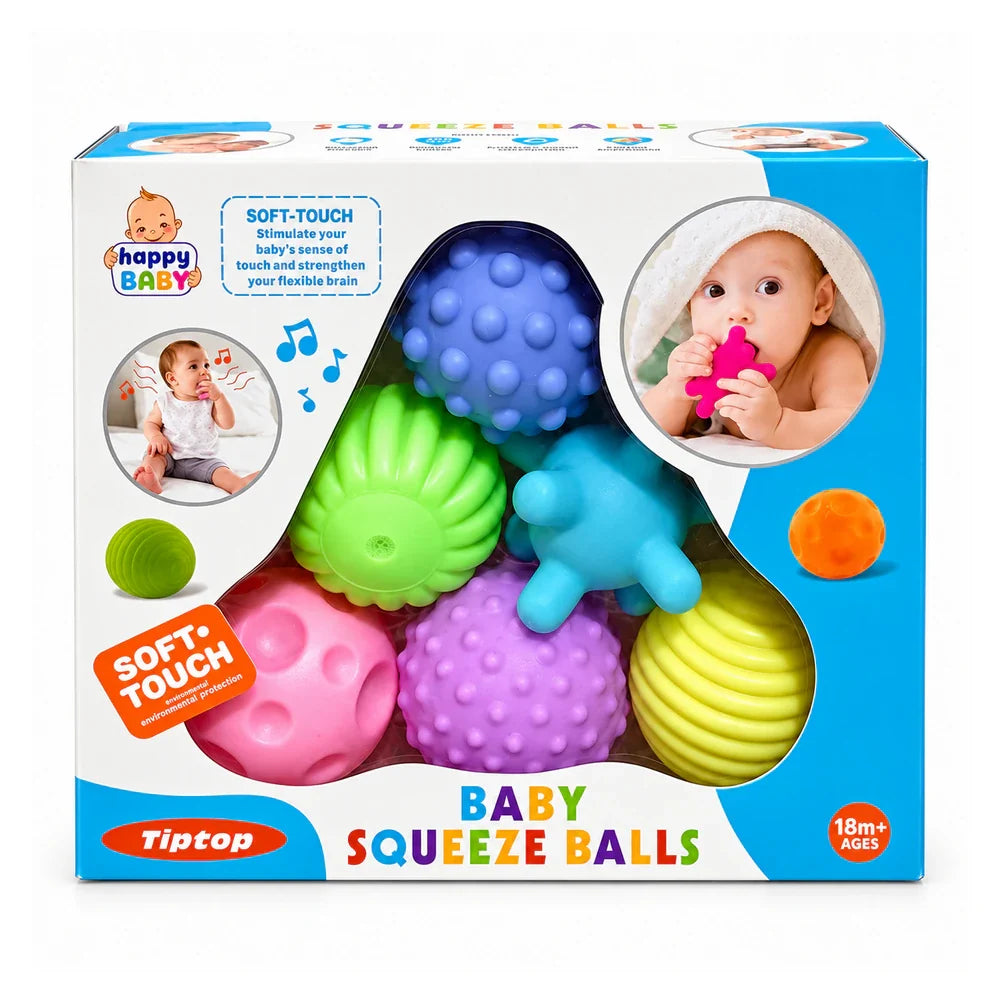
- Toys: the Textured Sensory Balls (ages 2–3), each ball with a different surface to feel.
Sensory-motor play for 3-year-olds and up
- Opposites with the whole body: crouch down low and say "I am small", stand up tall and say "I am big"; then fast and slow, quiet and loud (CDC).
- Movement: jumping, rolling, balancing and a cushion obstacle course (NHS children's therapy services).
- Mess-free: paint or gel sealed inside a zip bag to squish and draw on.
- Messy play at the child's pace: start with a spoon or a tool, then fingertips, then whole hands. Never force a hand in; two happy minutes beat ten that end in tears (NHS children's therapy services).
- Toys: the Water Colouring Mat (ages 3–5), My First Montessori Book: Touch Animals (ages 3–6), and the Buzz Wire Steady Hand Game (ages 3–5).
Safety
- Water: drowning is the leading cause of death for children aged 1 to 4, and it happens quickly and quietly, so a responsible adult watches closely and constantly whenever children are in or near water, including the bath (CDC). Young children can drown in 2.5 to 5 cm of water; empty buckets and basins straight after play (AAP).
- Small fillers: dried beans, lentils, rice, popcorn and nuts are popular in sensory bins, but whole beans, grains, nuts and seeds are on the CDC's list of choking hazards for young children (CDC). For under-threes, seal them in a zip bag, or use bigger things like cups, spoons and water.
- Water beads: the gel beads that grow in water. The US Consumer Product Safety Commission urges parents to remove them from any home with children and not to let children play with them, after thousands of swallowing injuries and the death of a 10-month-old (CPSC).
- Homemade dough: the CDC advises not letting children play with or eat dough made with raw flour, including homemade playdough, because germs are killed only when flour is baked or cooked (CDC). Salty dough is not for babies.
Sensitive to noise or textures? When to ask the doctor
Some children love messy, noisy play and others avoid it, and both are normal. If your child is often overwhelmed or reacts very strongly to sounds, textures or crowds, talk to their doctor. The American Academy of Pediatrics said in a 2012 statement that "sensory processing disorder generally should not be diagnosed" on its own, and that the child should be evaluated for the conditions that can cause sensory difficulties; occupational therapy may be part of a plan, but the evidence for sensory integration therapy is limited (AAP; AAP).
Questions parents ask
What is sensory play?
Play that uses the senses, touch, sound, sight, smell and taste, often together with movement. For babies and toddlers it's one of the main ways they learn about the world.
What sensory activities suit a 1-year-old?
Books with textures and flaps, emptying and filling containers, peek-a-boo under a cloth, touching foods of different textures, and bubbles to watch and pop, with you close by.
What sensory-motor games suit a 3-year-old?
Opposites games with the whole body (small and big, fast and slow), jumping and balancing, a cushion obstacle course, and messy play started with a spoon before hands.
Are water beads safe for children?
No. The US Consumer Product Safety Commission urges families to remove water beads from homes with children and not to let children play with them.
Can my child play with homemade playdough?
The CDC advises against letting children play with or eat dough made with raw flour, because germs are killed only when flour is baked or cooked.
About Kiddil: an online shop for toys and children's books in Egypt, for ages 0 to 12. Delivery to every governorate (EGP 50, free from EGP 1,500), cash on delivery and 14-day returns. All toys · Children's books