




Short Animal Stories for Kids: 5 Bedtime Stories About Animals
Published · Kiddil
Five short stories about animals, each about two minutes long, for bedtime or a quiet moment. Every story has a gentle lesson, a true fact about the animal, and two questions to talk about afterwards. They suit children from about three to eight.
1. Gamoul the Camel and the Last Drop
Gamoul the camel walked across the desert with his friends. The sun was hot, and the path was long. "I'm so thirsty," said little Farfour the goat.
Gamoul had some water in his skin bag, the last few drops. He could have drunk them himself. Instead, he bent down and poured them into Farfour's mouth.
"But you'll be thirsty too," said Farfour. Gamoul smiled. "Camels can walk a long way before they need to drink. Let's walk together. The oasis is near."
By evening they reached the palm trees and the cool water, and everyone drank until they were full.
True fact: a camel's hump doesn't hold water. It stores fat, which the camel's body can use when food is scarce.
Talk about it: Why did Gamoul give away his water? Have you ever shared something you wanted?
2. Dolly the Dolphin in the Red Sea
In the warm Red Sea, among the coral, lived Dolly the dolphin. One morning she heard a tiny voice: "I'm lost!" It was a small striped fish, far from her coral home.
"Hold on to my fin," said Dolly. They swam past orange coral and blue coral, past a sleepy turtle and a shy octopus. Every little while, Dolly swam up to the surface. "Where are you going?" asked the fish. "To breathe," said Dolly. "Dolphins breathe air, just like you!"
At last they found the striped fish's coral, and its whole family came out to cheer.
True fact: dolphins are mammals, not fish. They breathe air through a blowhole on top of their head, so they swim up to the surface to breathe.
Talk about it: How did Dolly help the little fish? Why did Dolly keep swimming up to the surface?
3. The Little Duckling's First Swim
Five ducklings followed their mother to the pond. Four jumped straight into the water, splash, splash, splash, splash. The fifth duckling stayed on the bank. "What if I sink?" she whispered.
Her mother swam over. "You don't have to jump. Try one foot." The duckling put in one foot. The water was cool and soft. Then the other foot. And then, before she knew it, she was floating.
"I'm swimming!" she quacked, paddling round and round. Her brothers and sisters cheered.
True fact: ducks have webbed feet that work like paddles, and their feathers are covered in oil that keeps the water out.
Talk about it: How did the duckling feel before she swam? What helped her to try?
4. The Ants and the Big Grain
A little ant found a grain of wheat, bigger than herself. She pushed, but it didn't move. She pulled, but it didn't move.
A second ant came to help, then a third, then ten more. Some lifted at the front, some pushed at the back, and step by step the big grain travelled across the garden to their home under the stones.
"Alone, I couldn't do it," said the little ant. "Together, it was easy!"
True fact: ants live and work together in colonies, and several ants often team up to carry food that is too big for one.
Talk about it: Why couldn't the little ant move the grain alone? When do we work together at home?
5. Hudhud the Hoopoe and the Old Tree
Hudhud the hoopoe had a beautiful crown of orange feathers. Every morning he opened it wide and called, "Hoo-poo-poo!" from the branches of an old tree in the village.
One day some children came with a rope to swing on the tree's weakest branch. "Please stop!" called Hudhud. "My nest is in that tree, and the branch is very old."
The children looked up and saw the tiny chicks peeping out. They tied their swing to a strong branch instead, and brought water for the tree's roots. Hudhud sang for them every day after that.
True fact: the hoopoe is a common bird in Egypt, easy to spot by its crest of feathers, which it raises like a crown.
Talk about it: What did the children do when they saw the nest? How can we look after trees and birds?
How to read these stories
Read slowly, do the animal voices, and pause to let your child guess what happens next. The Arabic versions are written in simple Modern Standard Arabic: hearing فصحى in stories early makes learning to read it at school easier (World Bank), and you can explain any new word in Egyptian Arabic.
Books and toys about animals
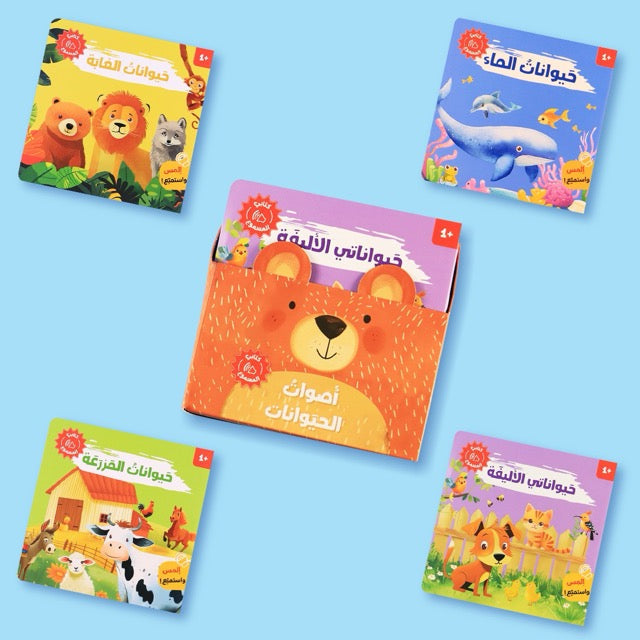
- My Sound Book: Animal Sounds (ages 1–4): hear each animal, then say it together.
- My First Montessori Book: Touch Animals (ages 3–6): animals to touch and trace.
- B Book: The Lion and the Mouse (ages 0–3): the classic fable in Arabic and English.
- Frog Life Cycle Figures (ages 3–6): how a frog grows, stage by stage.
More stories: 10 short moral stories, bedtime stories in Egyptian Arabic and stories about cleanliness.
Questions parents ask
What age are these animal stories for?
From about three to eight. Younger children enjoy the animal voices and pictures in their head; older ones can read the Arabic or English themselves.
Should I read the story in فصحى or tell it in Egyptian Arabic?
Both work. Reading the فصحى version gives your child early practice with the Arabic they'll read at school, and you can explain new words in Egyptian Arabic as you go.
Does a camel store water in its hump?
No. A camel's hump stores fat, which its body can use when food is scarce.
Read next: Short English stories with Arabic translation.
About Kiddil: an online shop for toys and children's books in Egypt, for ages 0 to 12. Delivery to every governorate (EGP 50, free from EGP 1,500), cash on delivery and 14-day returns. All toys · Children's books