



Baby Toys by Month: Toys and Play Ideas from Birth to 12 Months
Published · Updated · Kiddil
In short: a baby's best toy is you. The American Academy of Pediatrics puts it plainly: "The most educational toy is one that fosters interactions between caregivers and children" (AAP, 2019). Simple toys that you play with together, like high-contrast books, rattles, soft balls and stackers, do more than flashing, talking gadgets, and no single toy is needed for any milestone (AAP). Choose by the age on the box, and keep anything small enough to swallow out of reach.
How to boost your baby's development
Babies' brains grow through "serve and return": your baby babbles, looks or reaches, and you answer with a look, words or a hug, back and forth like a game of tennis (Harvard Center on the Developing Child). In the first years, more than a million new connections form in the brain every second (Harvard). Five things to do:
- Notice what your baby is looking at, and look at it together.
- Respond: smile, talk, pick them up.
- Name it: "that's the ball", "you're hungry".
- Take turns and wait for your baby's reply, even if it's a coo.
- Notice when they've had enough, and follow them to the next thing (Harvard).
The AAP adds reading together every day, singing and rhyming, regular routines, and praising small successes (AAP). None of it needs a toy or an app.
Birth to 2 months
Newborns prefer black-and-white and high-contrast patterns and the human face, and see best at about 20 to 30 cm, the distance to your face when you feed them (AAP; AAP).
- Toys: high-contrast pictures and books, a sturdy rattle to shake for them, and soft music (AAP). A first board book, like A Day in a Child’s Life: At Home (ages 0–3), is for reading aloud from now on.
- Play: hold a rattle to one side of your baby's head, shake it and see if they look for the sound; copy their sounds and see how long you can "talk" back and forth (CDC).
Months 3 and 4
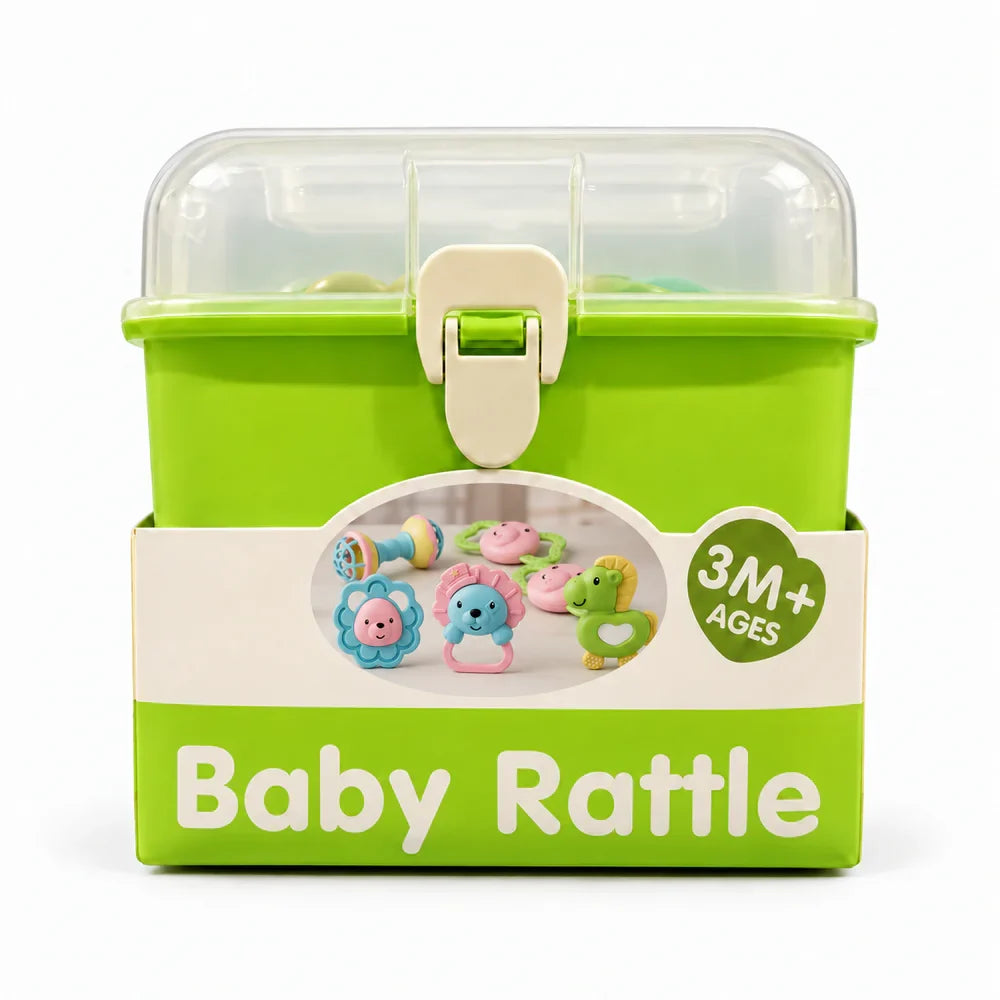
- Toys: see-through rattles, cloth books with bright pictures, an unbreakable baby mirror, soft balls and textured toys that make gentle sounds (AAP). The Baby Rattle Set is labelled from three months.
- Play: give your baby safe toys that are easy to hold; move a bright toy slowly left and right to see them follow it; and play peek-a-boo (CDC).
- Floor time: playing on the floor or a play mat every day helps babies move, learn and explore; try not to keep them in swings, strollers or bouncy seats for long (CDC).
Months 5 and 6
- Toys: soft balls, textured toys, toys with finger holds, rattles and small shakers with no parts that can come loose, and board or cloth books (AAP). The Baby Rattle and Teether Set pairs rattles with soft teethers.
- Play: put toys just out of reach to encourage rolling; whisper, clap and make funny noises to see which sounds they like; and when they drop a toy, give it back, a game that teaches cause and effect (CDC).
- Mouthing is learning: babies explore with their mouths, and teething can start around four months, so keep toys clean (ZERO TO THREE).
Months 7, 8 and 9
- Toys: blocks and a container to empty and fill, balls to roll, and books with flaps and textures.
- Play: dump blocks out of a container and put them back together; pass a toy back and forth, "my turn, your turn"; hide a toy under a blanket while they watch; and describe what they're looking at, "a red, round ball" (CDC).
- From home: at this age babies are fascinated by wooden spoons, plastic containers, and pots and pans (AAP).
Months 10 to 12
- Toys: ring stackers, like the Fish Ring Stacker or the Rainbow Ring Stacking Column (ages 0–1), push toys for early walkers, like the Wheeled Ring Stacker, and board books with things to feel or flaps to lift.
- Play: play together with blocks and other toys that use the hands, point out interesting things you see, and give them pots and pans or a small drum to bang (CDC). Sit facing each other and roll a ball back and forth (AAP).
- Attention grows: an eight-month-old spends two or three minutes with one toy; by twelve months it can be around fifteen (AAP).
For the first birthday and after, see gifts for 1-year-olds and the best toys for 1- and 2-year-olds.
Tummy time
Start the day your baby comes home: two or three times a day for three to five minutes, working up to 15 to 30 minutes a day by seven weeks. Only while your baby is awake and you are watching, and a toy or your face in front of them helps (AAP). The World Health Organization recommends at least 30 minutes of tummy time spread through the day for babies who can't move around yet (WHO).
Screens
No screen time for babies, except video calls with family. Babies learn by talking, playing and interacting with people (CDC; WHO).
Toy safety for babies
- Bigger than the mouth. Every toy and part should be larger than your baby's mouth (AAP). In the US, toys for children under three can't have parts that fit into a test cylinder 3.17 cm wide and 5.7 cm long (CPSC).
- Hanging toys: mobiles and cot gyms must be out of reach, and removed when your baby starts to push up on hands and knees or at five months, whichever comes first (AAP).
- No button batteries or strong magnets within reach, no long strings or ribbons, and no very loud toys (AAP).
- Follow the age on the box: it reflects choking risk as well as what the baby can do (AAP).
Questions parents ask
What is the best toy for a 3-month-old?
A rattle that's easy to hold, a cloth or board book with bright pictures, and an unbreakable baby mirror. At this age babies begin to hold a toy put in their hand and swing at toys (CDC), and your face is still their favourite thing to look at.
Are black-and-white toys good for newborns?
Yes, for the first months. Newborns prefer black-and-white and high-contrast patterns, and faces, and see best at 20 to 30 cm (AAP).
When should I start tummy time?
From the day your baby comes home, a few minutes two or three times a day while they're awake and watched, building up to 15 to 30 minutes a day by seven weeks (AAP).
Is it OK for my baby to put toys in their mouth?
Yes, if the toy is safe: mouthing is how babies explore. Choose toys too big to swallow, with no sharp or small parts, and clean them regularly (CDC; ZERO TO THREE).
How can I boost my baby's intelligence?
Talk, read and sing to your baby every day, respond when they babble or reach, and play simple games together. This back-and-forth builds the brain's connections; no special toy or app is needed (Harvard; AAP).
Read next: baby teething symptoms and safe relief.
About Kiddil: an online shop for toys and children's books in Egypt, for ages 0 to 12. Delivery to every governorate (EGP 50, free from EGP 1,500), cash on delivery and 14-day returns. All toys · Children's books