



Bilingual Arabic–English Books for Kids: Raising a Reader in Two Languages
Published · Kiddil
In short: children can learn Arabic and English at the same time. Learning two languages doesn't confuse them or delay their speech, and mixing the two is a normal stage. Read in the language you speak most comfortably, keep Arabic alive at home if school is in English, and use bilingual books so one story works in both languages.
What specialists say about two languages
Speech and language specialists are clear on the basics: using more than one language does not confuse children or cause speech or language delays, and blending words or grammar from both languages is an expected part of learning two at once (Communication Health Support Association, with ASHA). The same guidance recommends talking to your child in the language you are most comfortable with, and reading picture books together in your languages.
A bilingual child's words are often spread across the two languages: they may know "cat" in English and «بطة» (duck) in Arabic, but not the other way round. Count both languages together when you think about how many words they know.
Bilingual books by age
| Age | What works | Books to start with |
|---|---|---|
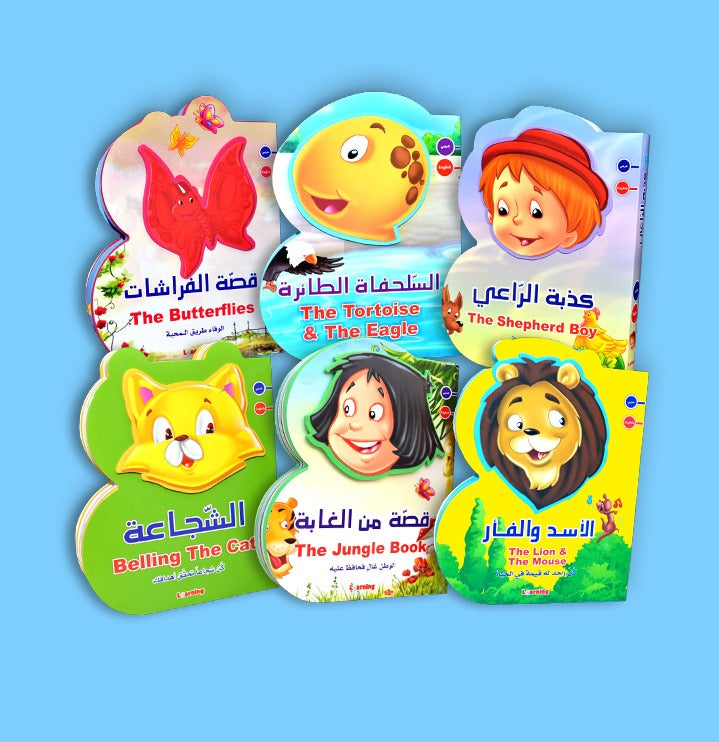
| 0–3 | Short fables in Arabic and English, one idea at a time | The B Book series: B Book: The Lion and the Mouse, B Book: The Shepherd Boy’s Lie, B Book: Courage |
| 2–5 | Interactive books and stories with a lesson | The Amazing Mask, Hidden Pictures activity books, Bilingual Moral & Fantasy Stories Series |
| 3–6 | Hearing both languages spoken, and longer story sets | The Caillou talking pen; the Stories of the Prophets in Arabic and in English |
| 5–8 | Vocabulary by topic, and looking words up | My First Illustrated Arabic–English Dictionary |
How to read a bilingual book together
- Read in your stronger language. If you are more comfortable in Arabic, read the Arabic text and let the English wait. A fluent, expressive reading matters more than covering both languages.
- Don't translate line by line. Read the story once in one language, and next time in the other. Children enjoy recognising the same story in new words.
- Let your child answer in either language. If they answer an Arabic question in English, carry on naturally in Arabic; there is no need to correct the switch.
- Point to the words. Arabic reads right to left and English left to right, and a finger moving along the line shows that without a lesson.
- Reread favourites. Repetition is how new words stick, in any language.
Keeping Arabic strong when school is in English
In many Egyptian homes the school language is English and the home language is Egyptian Arabic, while children's books are written in Modern Standard Arabic. That is three kinds of language to juggle, and it is normal. Two habits help. Keep Arabic for bedtime, when your own words carry the story (try our short bedtime stories in Egyptian Arabic). And read stories your child cares about in Standard Arabic, such as the stories of the prophets, so it feels like a language of good stories and not only of school.
Where to buy bilingual children's books in Egypt
Kiddil stocks children's books in Arabic, in English and in both, with the age shown on every book's page. See the bilingual Arabic–English books, or browse all children's books. We deliver to every governorate, and you can pay cash on delivery.
Questions parents ask
Will learning Arabic and English together confuse my child?
No. Specialists say using more than one language does not confuse children or cause speech delays, and mixing words from both languages is a normal part of learning the two.
Should my child learn Arabic or English first?
Both can start from birth. Speak and read in the language you use most comfortably, and give the other language a regular place too, such as school, a grandparent, or bedtime books.
At what age can we start bilingual books?
From the first year. Board books with short text in both languages, like the B Book series (ages 0–3), work from the start, and from five to eight a picture dictionary lets children look words up themselves.
Is it a problem if my child mixes Arabic and English in one sentence?
No. Blending words or grammar from two languages is an expected part of learning both. Answer naturally, say their idea back in full, and keep reading.
Read next: How to help your child talk: play ideas, speech toys and milestones; Teaching your child English at home; Short English stories with Arabic translation.
About Kiddil: an online shop for toys and children's books in Egypt, for ages 0 to 12. Delivery to every governorate (EGP 50, free from EGP 1,500), cash on delivery and 14-day returns. All toys · Children's books