



How to Help Your Child Talk: Play Ideas by Age, Speech Toys, and When to Ask for Help
Published · Kiddil
In short: children learn to talk by talking with the people around them. Talking, reading and playing together every day is what helps most, and toys are useful because they give you something to talk about. Every child has their own pace, but if your child isn't reaching the milestones below, don't wait: talk to their doctor, who may check their hearing and refer you to a speech and language therapist.
What talking looks like, age by age
The US Centers for Disease Control and Prevention (CDC) lists the skills that most children, 75% or more, have by each age (CDC). If your child hasn't reached one yet, that is a reason to talk to the doctor, not a diagnosis.
| Age | Most children by this age (CDC) | Play that helps |
|---|---|---|
| 1 year | Wave "bye-bye", call a parent "mama", "dada" or another special name, and understand "no" | Name what they are looking at, and say sound words like "pop" and "bang" |
| 18 months | Try to say three or more words besides "mama" or "dada", and follow a one-step direction without gestures, like giving you the toy when you say "Give it to me" | Add a word to theirs, and ask "What is that?" over a picture book |
| 2 years | Say at least two words together, like "more milk", point to things in a book when you ask "Where is the bear?", and point to at least two body parts | Offer choices, and play "Where is…?" with books and puzzles |
| 2½ years | Say about 50 words, put two or more words together with an action word, like "doggie run", and name things in a book when you point and ask "What is this?" | Describe what you are doing together, and sort and name picture cards |
| 3 years | Keep a conversation going for at least two back-and-forth exchanges, ask "who", "what", "where" or "why" questions, say their first name when asked, and talk well enough for others to understand most of the time | Ask what is happening in a picture and what will happen next, and sing songs and rhymes |
Sources: CDC milestones at 1 year, 18 months, 2 years, 30 months and 3 years.
Seven habits that get your child talking during play
- Get down to their level. Face your child at eye level, so they see your face as well as hear your words (CDC).
- Add a word. If your child says "dog", say "Yes, a dog. Dogs say woof, woof." You show the next step without correcting them (CDC).
- Offer a choice. "Do you want an apple or an orange?" hands your child the word they need to answer (NHS).
- Wait. After a question, give your child time to point or answer before you answer for them (NHS).
- Talk about pictures. Read together and ask "What is that?", and from three, "What do you think will happen next?" (CDC).
- Play with sounds. Say fun sound words like "tap", "crash", "bang" and "pop", and sing songs and rhymes with actions (NHS).
- Talk in your home language. Chat with your child in the language or languages you speak at home (NHS). Learning Arabic and English together doesn't delay speech; see raising a child in two languages.
Screens and talking
The World Health Organization recommends no sedentary screen time at all for one-year-olds, and no more than an hour a day for children aged two to four, with less being better. It suggests reading and storytelling with a caregiver instead (WHO, 2019). The time you spend talking, reading and playing together is the time that builds language.
Toys that give you something to talk about
No toy teaches a child to talk on its own. The useful ones give you both something to name, describe and take turns over. These are the ones we would start with, all in our speech and language toys:
- From birth to 3: the A Day in a Child's Life books (at home, at the park, at the market) for everyday words, and I Read with My Child for reading together.
- From 1: My Sound Book: Animal Sounds, to hear each animal and then say it together, and My Family Learning Board, for the words for mother, grandmother, uncle and the rest.
- From 2: the Hidden Pictures books: find it, then name it, in Arabic or English.
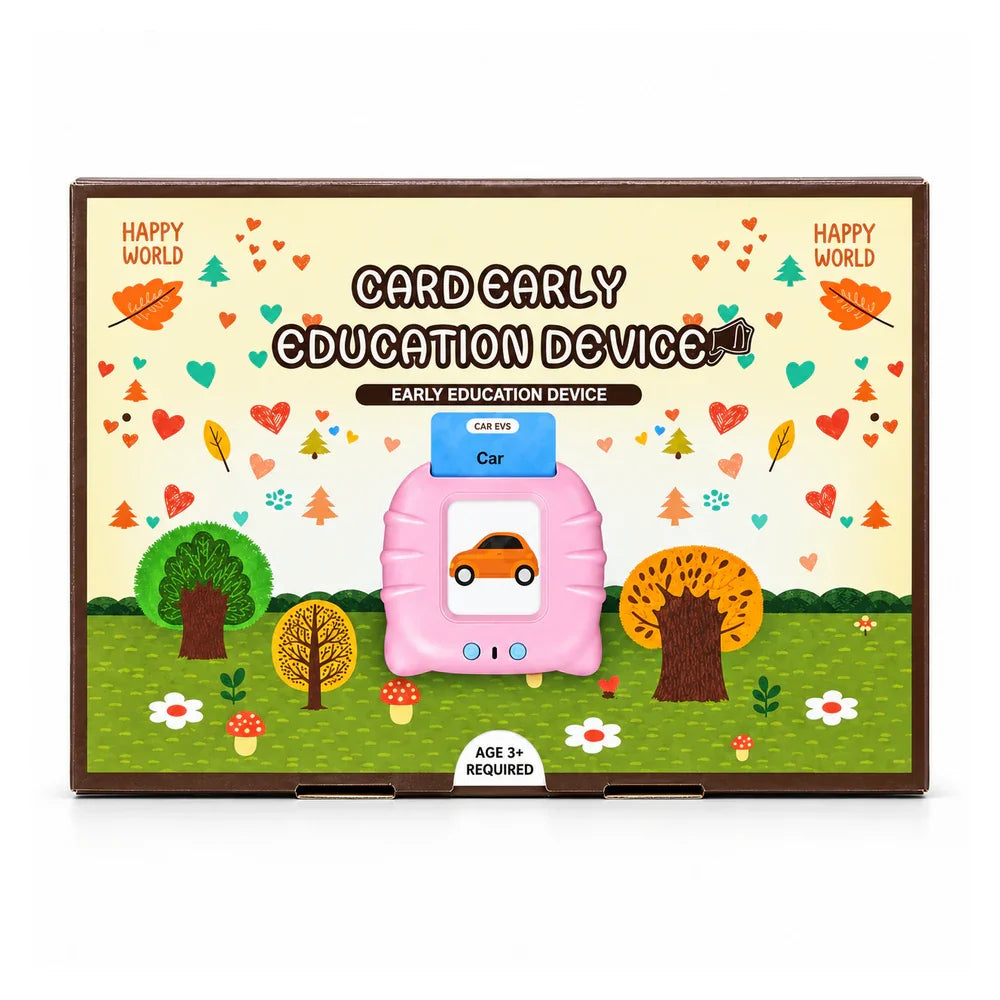
- From 3: the Talking Flash Card Reader, a first puzzle of household objects to name and then find at home, the Category Sorting Box, and Silly Sentences for building whole sentences.
- In two languages: the Caillou talking pen (ages 3–6) and My First Illustrated Arabic–English Dictionary (ages 5–8).
Getting the most from a talking flash-card reader
A talking card reader says each word clearly, as often as your child likes. It works best as something you use together:
- Let your child choose the card and slide it through, then say the word again yourself.
- Add to it: "Apple. A red apple. Where is our apple?", and go and find the real one.
- Ask about it: "What sound does it make?", "Where do we see it?"
- Keep it short, and stop while it is still fun.
Repeating words from a device is not the same as using words to ask for things. The American Academy of Pediatrics lists a child who can recite the alphabet, numbers or TV jingles but can't use words to ask for what they want among the signs to raise with the doctor (AAP).
When to talk to a doctor or speech therapist
The CDC's advice is not to wait. If your child isn't reaching one or more milestones, has lost skills they once had, or you have other concerns, talk to their doctor and ask about developmental screening (CDC). The doctor may order a hearing test and refer you to a speech and language therapist (AAP). In Egypt, your child's paediatrician is the place to start. Mention it if your child is:
- not saying three or more words besides "mama" and "dada" by 18 months;
- not putting two words together by 2;
- no longer saying words they used to say, at any age;
- hard for people outside the family to understand most of the time by 3.
The American Academy of Pediatrics' advice for every family is the same: spend lots of time playing with, reading to and talking with your child, and encourage them to "talk" to you with gestures and sounds (AAP).
Where to buy speech and language toys in Egypt
Kiddil stocks toys and books for talking and early language, with the age on every product page. See the speech and language toys, the first-words books and the bilingual Arabic–English books. We deliver to every governorate, and you can pay cash on delivery.
Questions parents ask
When do children start talking?
Around their first birthday, most children call a parent "mama", "dada" or another special name, and by 18 months most try to say three or more other words (CDC). By two, most put two words together. Children vary, so treat these ages as a guide to when to ask the doctor, not a deadline.
My child is two and hardly talks. What should I do?
By two, most children say at least two words together, like "more milk" (CDC). If your child doesn't, talk to their doctor now rather than waiting to see; the doctor may check their hearing and refer you to a speech and language therapist. In the meantime, talk, read and play together every day.
Do speech toys or talking flash cards treat a speech delay?
No. A speech delay is assessed and treated by professionals. Toys help when you use them together to name, describe and take turns, which is how children practise talking.
Does learning Arabic and English at the same time delay speech?
No. Specialists say using more than one language does not cause speech delays, and mixing the two is a normal stage. Count your child's words in both languages together.
Is it normal that my two-year-old's words are hard to understand?
Yes. Children at this stage often don't pronounce words clearly, and that is normal (Great Ormond Street Hospital). By three, most children talk well enough for others to understand them most of the time (CDC). If that isn't the case by three, mention it to the doctor.
My child is three and doesn't talk clearly. Is that normal?
By three, most children talk well enough for others to understand them most of the time, and keep a conversation going for at least two back-and-forth exchanges (CDC). If your child doesn't yet, mention it to the doctor, who may check their hearing and refer you to a speech and language therapist.
My child is four and isn't talking. What should I do?
Talk to their doctor as soon as you can rather than waiting. Most children are already having short conversations by three (CDC), and the earlier a hearing check and a speech and language assessment happen, the sooner your child gets the right help.
How much screen time is OK while my child is learning to talk?
The WHO recommends none for one-year-olds, and no more than an hour a day for children aged two to four, with less being better. Swap screen time for reading, songs and play together.
Read next: Child development stages, month by month.
About Kiddil: an online shop for toys and children's books in Egypt, for ages 0 to 12. Delivery to every governorate (EGP 50, free from EGP 1,500), cash on delivery and 14-day returns. All toys · Children's books