



How to Teach Your Child English at Home: Letters, Words and Songs, by Age
Published · Kiddil
In short: you don't need perfect English to teach your child. What matters most is enthusiasm and encouragement (British Council). Keep sessions short and daily, use songs, picture books and games, teach letters by their sounds, and don't correct every mistake. Keep Arabic strong at home too: learning two languages doesn't confuse children or delay their speech (ASHA).
Will English confuse my child or weaken their Arabic?
No. Using more than one language does not confuse children or cause speech or language delays, and a strong foundation in one language supports learning another (ASHA). Mixing words from both languages is an expected stage, and by about three most children can separate their languages (AAP and ASHA). Speak to your child in the language you're most comfortable with, and add English on top.
When should I start?
Young children pick up language naturally, without conscious effort, and children who acquire a language young tend to have better pronunciation (British Council). Start with the sounds and rhythm of English, songs, rhymes and stories, rather than lessons. Many children go through a "silent period" when they understand before they speak; don't force them to repeat words (British Council).
How to teach English at home, step by step
- Make a daily "English time". Short and frequent beats long and rare: fifteen minutes is enough for very young children (British Council). Start it the same way each day, "It's English time!", so your child knows what to expect.
- Sing songs with actions. They teach new words and pronunciation, and very young children can join in with the actions before they can sing (British Council).
- Read picture books together. Choose short texts, point to the pictures as you say the words, and read favourites again and again; repetition is how words stick (British Council).
- Use everyday things. Name what you're using: the cup, the spoon, the shoes while dressing. Home is full of real objects to practise with (British Council).
- Play with flashcards. Memory, Snap and Kim's game (hide one card, guess which is missing) make revision fun (British Council).
- Don't correct, repeat. If your child says "I goed", answer "Yes, you went". Correcting every mistake puts children off; hearing the right form works (British Council; British Council).
- Translate once, quietly, if you must. For a new idea, a quick whispered translation, then straight back to English (British Council).
Worried about your accent? Young children adjust their accent to the English around them, and you don't need to sound like a native speaker to communicate (British Council). British Council Egypt republished the same advice for parents here (British Council Egypt).
English letters: sounds first, then names
Letters have a name ("bee") and a sound (/b/), and reading uses the sound. The British Council suggests introducing the small letters by their sounds rather than their names, starting with easy consonants like b, d, m and t; alphabet songs sing the names, so explain that each letter has both (British Council). This is phonics: English has 26 letters for about 44 sounds, and children learn to match letters to sounds and blend them, c-a-t makes "cat" (UK Department for Education). Say the sounds cleanly, /s/ not "suh".
Capital or small letters first?
Small letters first, because almost all the words children read are written in them; capitals come with names and the start of sentences. By the end of kindergarten, children learn to recognise and name both (Reading Rockets).
24 first English words with three letters
Three-letter words where each letter makes its usual sound are the first words children can blend: say each sound, then run them together. Point to the thing as you say it.
| English | Arabic | English | Arabic |
|---|---|---|---|
| cat | قطة | dog | كلب |
| sun | شمس | hat | طاقية |
| bed | سرير | bus | أتوبيس |
| cup | كوباية | pen | قلم |
| box | علبة | fox | تعلب |
| hen | فرخة | bag | شنطة |
| red | أحمر | big | كبير |
| hot | سخن | run | يجري |
| sit | يقعد | leg | رجل |
| fan | مروحة | map | خريطة |
| net | شبكة | pot | حلّة |
| jam | مربى | six | ستة |
From words to sentences
Children build sentences gradually: "a dog", then "a brown dog", then "a brown and black dog" (British Council). With young children there's no need to teach grammar rules; let them hear and use sentences in context (British Council). Games like Silly Sentences (ages 3–8) make building a sentence part of the fun.
Screens and English
Babies under 18 months struggle to learn from a screen, and good educational videos work better when you watch together (American Academy of Pediatrics, 2026). For babies, songs and stories in your own voice do more than any video (AAP).
By age
- 0 to 2: songs, rhymes and picture books in your voice, in English and Arabic. Try For Young Readers — 12 English Stories (ages 1–4).
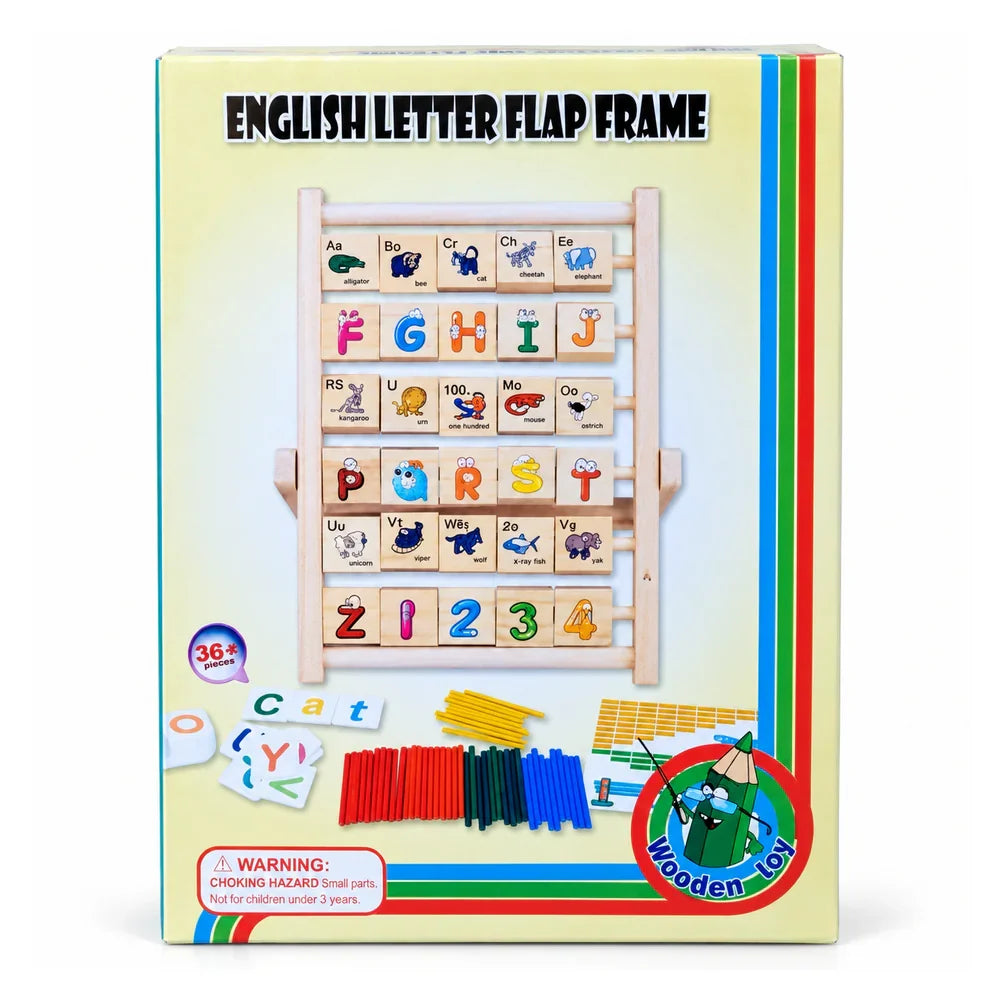
- 3 to 4: a daily English time, action songs, flashcards and letter sounds. The Talking Flash Card Reader (ages 3–5) says each word clearly, and the Wooden English Alphabet Flip Board (ages 3–6) pairs each letter with a picture.
- 5 to 6: blending three-letter words, first sight words and writing their name. Sight Words Swat (ages 3–8) turns common words into a race, and the Caillou talking pen (ages 3–6) reads English and Arabic aloud.
- 7 and up: spelling games like the Spelling Dice Race (ages 6–8), and a picture dictionary, My First Illustrated Arabic–English Dictionary (ages 5–8).
More in letters and reading toys and bilingual Arabic–English books.
Questions parents ask
How can I teach my child English at home if my own English is weak?
Your enthusiasm matters more than perfect English. Use songs, picture books with short texts, and audio stories, and learn alongside your child; showing that it's fine to "have a go" and make mistakes helps them too (British Council).
Should I teach English letters by name or by sound?
By sound first, because reading uses the sounds, starting with small letters and easy consonants like b, d, m and t. Explain that alphabet songs sing the letters' names.
Capital letters or small letters first?
Small letters first, since almost everything children read is in small letters. Capital letters come next, for names and the start of sentences.
Will learning English affect my child's Arabic?
No. Learning more than one language doesn't confuse children or cause delays, and keeping Arabic strong at home supports their English (ASHA; AAP).
My child understands English but doesn't speak it. Why?
Many children go through a silent period when they listen and understand before they speak. Keep the English coming and don't force them to repeat words; speaking follows (British Council).
What are the first English words to teach a child?
Words from their world: family, food, toys, animals, colours and numbers, and simple three-letter words like cat, dog, sun and cup, which they can later sound out.
Read next: Short English stories with Arabic translation.
About Kiddil: an online shop for toys and children's books in Egypt, for ages 0 to 12. Delivery to every governorate (EGP 50, free from EGP 1,500), cash on delivery and 14-day returns. All toys · Children's books