



Blocks or Puzzles for Ages 3–6? A Parent's Buying Guide
Published · Kiddil

Both blocks and puzzles can be good play choices. The useful question is what your child enjoys and what the pieces let them do. The AAP suggests blocks and puzzles among simple play materials, while NAEYC recommends both for exploring spatial ideas and words (AAP on play; NAEYC on spatial play). Neither category is a guaranteed shortcut to a particular learning result.
The difference in one minute
| Consider | Building blocks | Jigsaw puzzle |
|---|---|---|
| Goal | Invent and change a structure | Fit pieces into a finished picture |
| Repeat play | A different build each time | Same picture, new strategy or faster familiarity |
| Space | Often needs a play surface and storage box | Needs a flat surface; piece count matters |
| Good first question | Does the child like making scenes and stories? | Does the child enjoy matching pictures and completing a scene? |
Choose blocks when...
Your child turns household objects into houses, roads or pretend worlds, and likes rebuilding. Kiddil's Wooden City Blocks is labelled ages 3–6. The set has houses, towers, trees, a car, figures and a base. It suits an adult who can start with a simple layout and let the child take over. See seven ways to play with blocks for concrete ideas.
Choose a puzzle when...
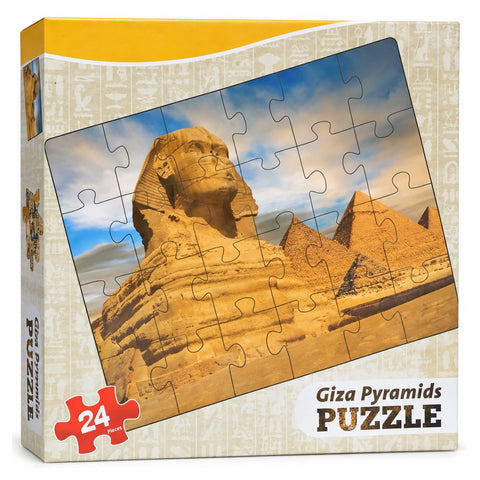
Your child likes an image to complete and wants a clear end point. A 24-piece Giza Pyramids puzzle is also labelled ages 3–5. The number of pieces is one factor; picture detail, piece size and the child's experience matter too. Start together, sort edge or colour clues if useful, and pause before frustration takes over. Do not assume every child of the same age will finish the same puzzle alone.
If you are buying one gift
- Check the exact package age and safety warnings; do not use a category name as an age recommendation.
- Ask whether your child prefers an open story or a picture to complete.
- Consider where the pieces will be stored and whether a younger sibling can reach them.
- Choose a theme the child already cares about. Interest usually matters more than a generic “educational” label.
The CPSC toy safety advice says to follow age guidance and keep small parts away from children under three. Inspect pieces regularly and stop using damaged toys. If you want variety, a small puzzle and a building set can complement each other; there is no need to buy both at once.
What to browse next
Compare Kiddil's building blocks and puzzles by the box age and the child's interests. The City Blocks parent guide shows how to begin if you choose that set.
Questions parents ask
Which is better for learning, blocks or puzzles?
They offer different play experiences. Blocks invite changing structures and stories; a jigsaw has a picture goal. Choose by your child's interest and join the play with useful conversation (AAP; NAEYC).
Is a 24-piece puzzle always easy for a three-year-old?
No. Images, piece shape, experience and interest all affect difficulty. The Giza set's box says ages 3–5, but an adult may need to help.
Are these safe with a baby at home?
Store small pieces where the baby cannot reach them. Use only toys appropriate for each child's own age and follow the product warnings (CPSC).
Toys in this guide
Check each toy's age, contents and warnings before choosing. Prices and availability come from the store.


About Kiddil: an online shop for toys and children's books in Egypt, for ages 0 to 12. Delivery to every governorate (EGP 50, free from EGP 1,500), cash on delivery and 14-day returns. All toys · Children's books