




How to Teach Your Child to Read and Write Arabic, Step by Step
Published · Kiddil
In short: reading starts long before school, with talking and reading aloud from birth (AAP). To read Arabic, children learn each letter's sound, read words with harakat (the short-vowel marks) first, and learn the letter shapes that change with their place in a word and the dots that tell similar letters apart. Accuracy comes before speed, and reading without harakat comes later, when the child is ready. Writing grows from strong hands and practice forming each letter.
Why Arabic has its own challenges
- Two forms of the language. Children speak Egyptian Arabic at home but learn to read in Modern Standard Arabic (فصحى), so at school they meet a form of the language they don't speak. Hearing فصحى early, for example in stories read aloud, eases that move (World Bank).
- Letters change shape. Arabic is joined-up and written right to left; most letters have four forms depending on where they sit in a word (Yassin and colleagues, 2020), and six letters, ا د ذ ر ز و, never join the letter after them (Asadi and Asli-Badarneh, 2026).
- Dots matter. Many letters share one shape and differ only in their dots, like ب ت ث (Asadi and Asli-Badarneh).
- A helpful fact: every Arabic letter's name starts with its sound, which makes letter–sound links easier to learn (World Bank).
Step by step
- Read aloud every day, from birth. The American Academy of Pediatrics recommends shared reading from birth, and print books with rich language are best (AAP). Include stories in فصحى, and explain new words in Egyptian Arabic.
- Play with sounds. Rhymes, clapping the syllables in a name, and finding words that start with the same sound all come before letters (UK Department for Education).
- Learn letter sounds. Teach each letter with its sound, starting with its stand-alone shape, then its other forms. Group letters that share a shape so the dots stand out: ب ت ث ن, ج ح خ, د ذ, ر ز, س ش.
- Read with harakat. Words with the short-vowel marks are fully "readable", which is why children's books and the first school years use them (Yassin and colleagues). Most Arabic reading methods go in roughly this order: a letter with fatha, kasra and damma (بَ بِ بُ), long vowels (با بي بو), sukun, then shadda and tanween, short words, and sentences.
- Blend and re-read. Sound out each letter and join the sounds into a word. Re-reading the same short text makes more words instant; pushing for speed doesn't (UK Department for Education).
- Talk about the book. Ask what, where and why questions, add to your child's answers ("yes, a red car"), and let them tell the story back (Reading Rockets).
Reading without harakat
Most printed Arabic has no short-vowel marks. In schools, unvowelized text is generally expected from around the fourth year of primary, and the World Bank advises moving on when the child's reading is ready, not at a set age (World Bank). Readers then rely on their vocabulary and the sentence to know how a word is read (Asadi and Asli-Badarneh). A gentle start: take a text your child already reads well with harakat and read it together without them.
How to help your child read faster
Accuracy first: beginners have to work through each letter to build a store of words they recognise at a glance, a process that needs accuracy before any push for speed (World Bank). Re-reading familiar, easy texts is what builds fluency; a child can only read as fast as they can decode (UK Department for Education).
Writing: on dots, then on the line
- Strong hands first. Letters need hand control: playdough, threading and drawing come before the pencil. See how to teach pencil grip.
- Big movements, then small. Practise a letter's movement in the air or with a finger in sand, then on paper, learning where each letter starts, which way it goes and its shape (UK Department for Education).
- On dots, then on the line. Tracing dotted letters teaches the movement; writing on a line teaches size and position. Start with the stand-alone forms, then join letters into words (Asadi and Asli-Badarneh).
- Their name first. By five, most children write some letters of their name (CDC).
What to expect by age
- 3 to 4: spots rhymes, claps syllables, hears words that start with the same sound, and writes some letters of their name (UK Department for Education).
- 5: names some letters when you point to them, writes some letters of their name, and recognises simple rhymes (CDC).
- 6 to 7: with good teaching, most children learn to read at six or seven; a few read at four or five, and some need extra support until eight or nine (NAEYC).
Books and toys that help
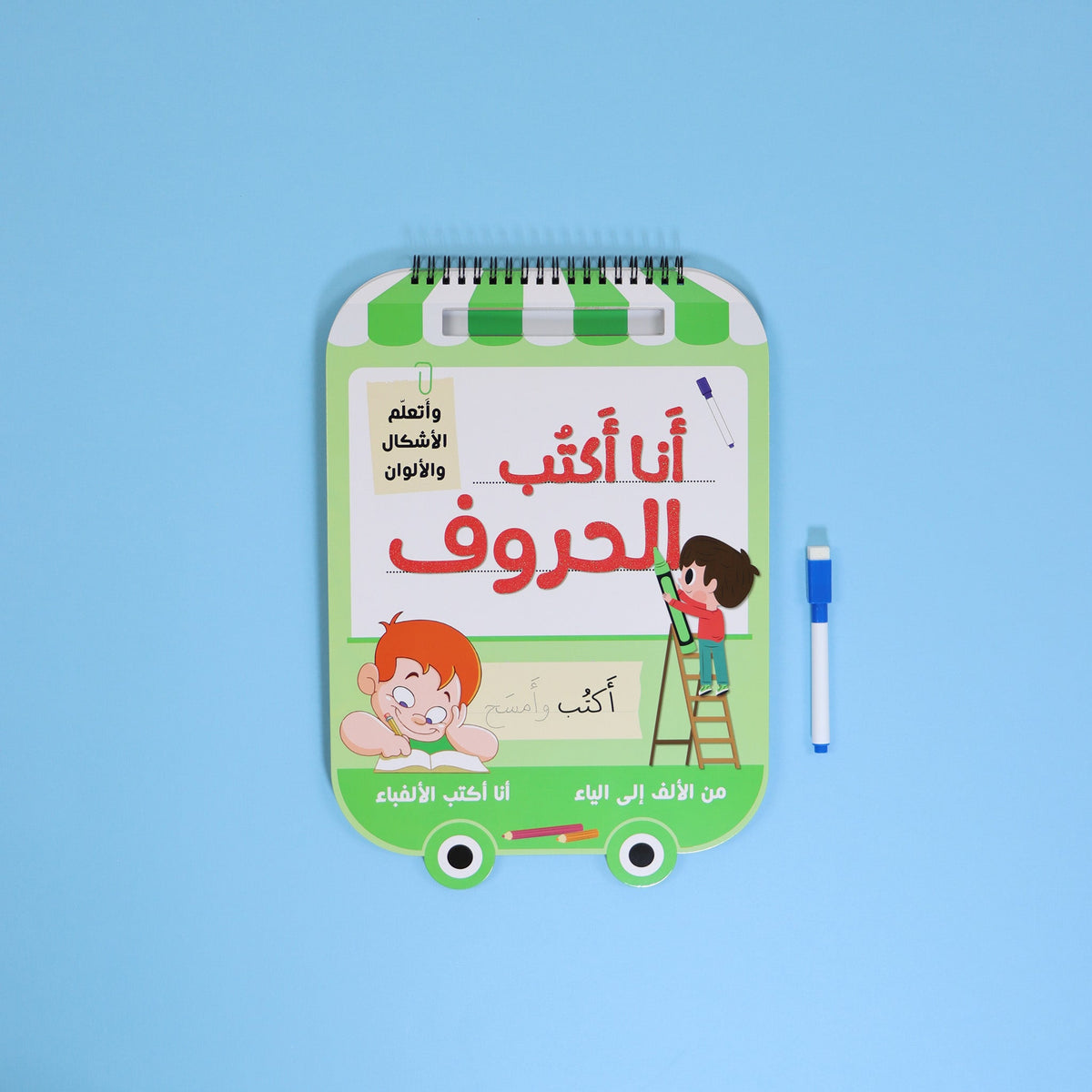
- Learn Arabic Letters (ages 3–5) and Write & Wipe: Arabic Letters (ages 3–6): letters to trace, wipe and try again.
- Learn Arabic Words (ages 3–5): first words with pictures.
- Stories in فصحى to read aloud: Stories of the Prophets in Arabic (ages 3–6) and the bilingual B Book fables (ages 0–3).
- The Caillou talking pen (ages 3–6), which reads Arabic and English aloud.
More in first-words books and teaching letters and numbers through play.
Questions parents ask
How do I teach my child to read Arabic?
Read aloud every day, play with sounds and rhymes, then teach each letter with its sound, read words with harakat, blend sounds into words and re-read short texts. Group similar letters so the dots stand out.
Should my child learn to read with harakat or without?
With harakat first: they make every word readable, which is why children's books and the first school years use them. Reading without them comes when the child reads fluently with them, generally from around the fourth year of primary.
How do I teach my child to read without harakat?
Once they read fluently with harakat, take a text they already know well and read it together without the marks. Their vocabulary and the meaning of the sentence tell them how each word is read.
How can I get my child to read faster?
Focus on accuracy first, then re-read familiar, easy texts. Speed grows as more words become instant; pushing a child to read faster doesn't work.
At what age do children learn to read and write?
Most children learn to read at six or seven; some read at four or five, and others need more support. By five, most name some letters and write some letters of their name.
How do I teach my child to write on the line?
Start with the letter's movement in the air or sand, then trace dotted letters, then write on a line, learning where each letter starts and which way it goes. Begin with the letters of their name.
Read next: Short animal stories for kids.
About Kiddil: an online shop for toys and children's books in Egypt, for ages 0 to 12. Delivery to every governorate (EGP 50, free from EGP 1,500), cash on delivery and 14-day returns. All toys · Children's books