



Easy Science Experiments for Kids at Home: Step by Step, by Age
Published · Kiddil
In short: the best science experiments for children use things already in your kitchen, take a few minutes, and end with a question: "why did that happen?" Below are twelve tried experiments from science-education sources, grouped by age, each with what you need, the steps and the simple science. An adult stays with the child for every one, nothing used in an experiment gets eaten, and balloons, magnets and batteries follow the safety rules at the end.
Why do science at home?
Young children naturally observe, explore and ask questions, and everyday life is full of science: cooking, water, plants and play. The US National Science Teaching Association puts it simply: "Parents and other caregivers can nurture children's natural curiosity about the world around them" (NSTA, 2014). The learning happens when you ask your child to guess what will happen, try it, and talk about what they saw.
Experiments for kindergarten (ages 3 to 6)
1. Magnet fishing: what sticks?
You need: a stick, 30 cm of string, a fridge magnet, and a tray of household things: paper clips, a spoon, keys, bottle caps, cotton wool, a crayon, a plastic toy.
Steps: tie the magnet to the string and the string to the stick. Before fishing, your child guesses which things will stick. Fish, and sort the catch into "sticks" and "doesn't stick".
Why: magnets pull on iron and steel. Plastic, wood, paper and many metals, like aluminium, don't stick, so "metal" doesn't always mean "magnetic". Keep magnets away from phones and screens (PBS KIDS).
2. A bean in a jar
You need: 3 or 4 dried beans, kitchen paper, a clear jar (plastic is safer), water.
Steps: soak the beans in water overnight. Line the jar with damp kitchen paper and slide the beans between the paper and the glass so you can see them. Add a little water every day to keep the paper damp. Within about a week the beans sprout; measure the stem each day (PBS KIDS).
Why: the dry seed soaks up water and wakes up. The tiny plant inside uses food stored in the bean to push out a root first, then a shoot.
3. Walking water
You need: three or more clear glasses, water, food colouring, kitchen paper.
Steps: fill every other glass with water and colour each one differently. Fold kitchen paper into strips and bridge each full glass to the empty one next to it. Check after 20 minutes, a few hours and the next day (Science Buddies).
Why: water creeps along the tiny gaps between the paper's fibres, climbs over and fills the empty glass, and two colours meet to make a new one.
4. A rainbow in milk
You need: full-fat or semi-skimmed milk, a flat plate, food colouring, washing-up liquid, cotton buds.
Steps: cover the plate with milk and add a drop of each colour. Touch the milk with a plain cotton bud: nothing happens. Now dip the other end in washing-up liquid and touch the milk again: the colours race away and swirl (Science Buddies).
Why: soap weakens the milk's surface "skin" where it touches, and the stronger surface around it pulls the milk and colours outward. Don't drink the milk afterwards; it has soap in it.
5. Lemon volcano
You need: a lemon, a tray, baking soda, food colouring, a spoon.
Steps: an adult cuts the top and bottom off the lemon so it stands up. Mash the inside a little, add a few drops of colouring, spoon baking soda on top and stir: it foams. Keep adding soda until the fizzing stops (Science Buddies).
Why: lemon juice contains citric acid, which reacts with baking soda and releases carbon dioxide gas, the bubbles in the foam. When the acid is used up, it stops.
6. The paper ball that won't go into the bottle
You need: a small square of paper, an empty wide-mouth plastic bottle.
Steps: crumple the paper into a ball that fits the bottle's mouth easily. Lay the bottle on its side, put the ball just in front of the mouth and try to blow it in. It flies back out (Science Buddies).
Why: the "empty" bottle is full of air. The air you blow in has nowhere to go, so it rushes back out and carries the ball with it.
Experiments for ages 5 to 8
7. The egg that floats
You need: a raw egg, two glasses of water, salt, a spoon.
Steps: lower the egg into plain water: it sinks. Stir plenty of salt into the second glass until it dissolves, and lower the egg in: it floats (Science Buddies).
Why: salt makes water heavier for the same amount, or denser. Once the water is denser than the egg, the egg floats. Wash hands after handling raw egg.
8. Lift an ice cube with a string
You need: a glass of cold water, ice cubes, a 20 cm piece of string, salt.
Steps: lay the string on a floating ice cube and try to lift it: it slips off. Now lay the string on the cube, sprinkle salt on it and wait two or three minutes. Lift: the cube comes up with the string (Science Buddies).
Why: salt melts a little of the ice around the string, and that melting chills the water so much that it freezes again, around the string.
9. Fireworks in a glass
You need: a clear glass of water, a small bowl, a tablespoon of cooking oil, food colouring, a fork.
Steps: whisk the oil with 10 to 20 drops of colouring; they won't mix, and the colour stays in little beads. Pour the mixture gently onto the water and watch colour burst out of the oil and fall through the water (Science Buddies).
Why: oil is lighter than water and doesn't mix with it, so it floats. The water-based colouring sinks through the oil and spreads once it reaches the water. Put used oil in the rubbish, not down the sink.
10. Dancing sprinkles
You need: a bowl, cling film, a rubber band, coloured sprinkles or salt.
Steps: stretch the cling film tight over the bowl and hold it with the rubber band. Scatter sprinkles on top. Put your mouth near the bowl, without touching it, and hum loudly: the sprinkles bounce (Science Buddies).
Why: sound travels through the air as vibrations that shake the thin film, just as sound shakes your eardrum. The sprinkles let you see it.
11. The can that follows a balloon
You need: an empty drink can, a balloon, dry hair, a smooth floor.
Steps: an adult blows up and ties the balloon. Lay the can on its side. Rub the balloon on dry hair, then hold it a few centimetres from the can: the can rolls towards it without being touched (Exploratorium).
Why: rubbing gives the balloon a charge of static electricity, which attracts the near side of the can.
12. A celery stalk that changes colour
You need: a celery stalk with leaves (or a white flower), a glass, half a cup of water, a teaspoon of blue or red food colouring.
Steps: mix the water and colouring. An adult cuts the bottom of the stalk with a knife, and you stand it in the coloured water. Check after 2 hours, 24 hours and 48 hours: the colour climbs to the leaves (Science Buddies).
Why: water travels up thin tubes in the stem to the leaves, where it evaporates, and the colour is left behind.
For 8 and up
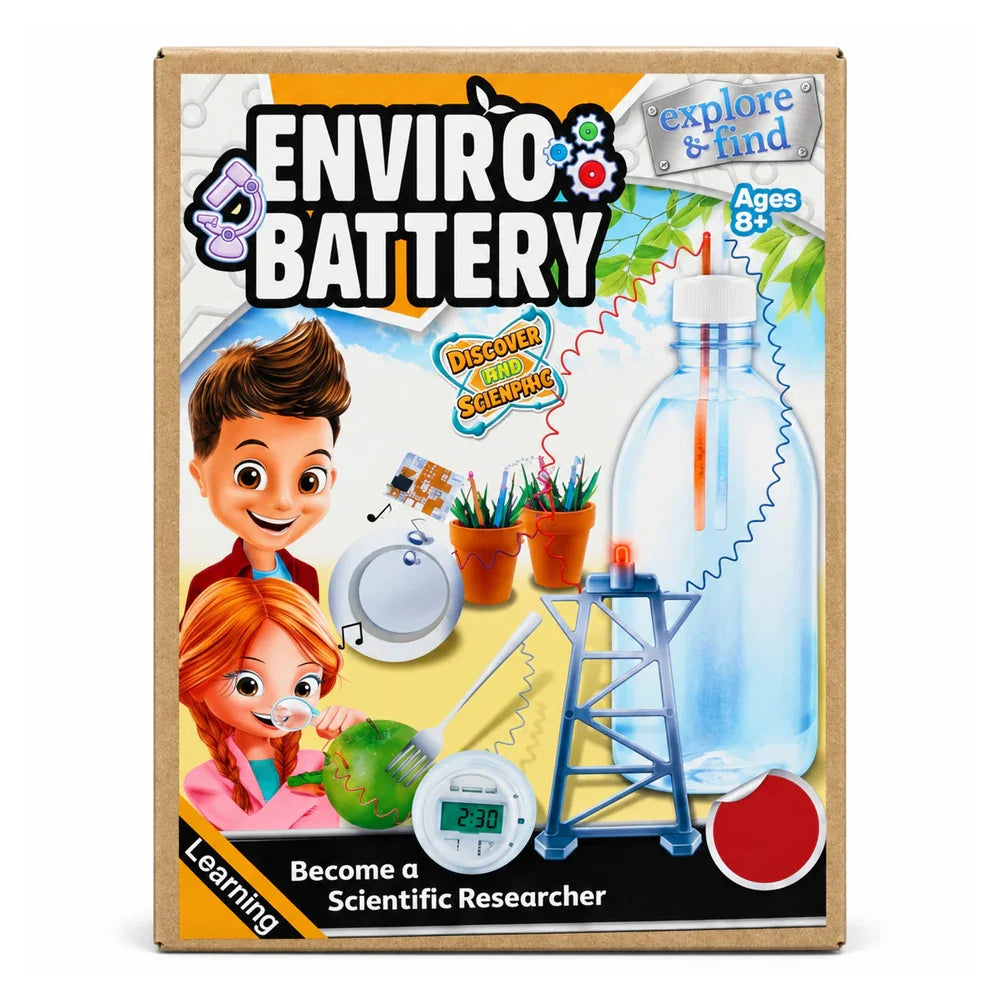
- A lemon battery: two different metals in lemon juice make a small electric current. The Enviro Battery Kit (ages 8–10) has the parts to light it up. Never connect any experiment to a wall socket.
- A balloon blown up by a reaction: baking soda in a balloon, vinegar in a small bottle, and the gas they make fills the balloon (Science Museum Group). Only the stretchy balloon closes the bottle, never a cap or lid, because the gas builds pressure.
A science project for school
Any experiment above can become a school project: write the question, your guess, what you did, what you saw (drawings or photos help), and why you think it happened. Change one thing and try again, like more salt or a different colour.
Science kits and books
- Magnets: Magnetic Rods and Balls (ages 3–5).
- Plants and life cycles: Little Explorer: Seeds & Planting (ages 2–5), Frog Life Cycle Figures (ages 3–6), and the Grow-a-Maze Kit (ages 8–10).
- Electricity: Electronic Circuit Blocks (ages 3–6) and the Traffic Light Circuit Kit (ages 6–8).
- Looking closer: the Children's Microscope Kit (ages 6–8) and the Weather Station Kit (ages 8–10).
See all our science kits and science and discovery toys.
Safety rules for experiments at home
- An adult is there for every experiment, and handles knives, glass and anything hot. Nothing used in an experiment gets eaten (Royal Society of Chemistry).
- Balloons: the US Consumer Product Safety Commission warns that children under eight can choke or suffocate on uninflated or broken balloons, and that adult supervision is required. An adult blows up the balloon, and broken pieces go straight in the bin (CPSC).
- Small things like beans, sprinkles, paper clips and caps are choking hazards for children under three.
- Magnets: use one large fridge magnet. Small high-powered magnets are dangerous if swallowed, because two or more pull together inside the body; if you think a child swallowed one, get medical help straight away (CPSC).
- Button batteries stay out of children's experiments: one can burn through a child's throat in as little as two hours if swallowed (CPSC).
- Never seal a bottle with a cap or lid while baking soda and vinegar are reacting, and never look straight at the sun.
Questions parents ask
What is the easiest science experiment for kids at home?
Walking water, the rainbow in milk and the lemon volcano need only kitchen things and work for children from about three, with an adult helping.
Which experiments suit kindergarten?
Magnet fishing, a bean in a jar, walking water, the rainbow in milk, the lemon volcano and the paper ball in the bottle.
What is a simple experiment about magnets?
Magnet fishing: tie a fridge magnet to a string and fish in a tray of household things, sorting what sticks from what doesn't. Magnets attract iron and steel, not plastic, wood or aluminium.
What is a simple experiment about plants?
Grow a bean in a jar between damp kitchen paper and the glass, or stand a celery stalk in coloured water and watch the colour climb to the leaves.
Are baking soda and vinegar experiments safe?
Yes with an adult, as long as the container is never sealed with a cap or lid, because the gas they make builds pressure. A stretchy balloon is the only safe cover.
About Kiddil: an online shop for toys and children's books in Egypt, for ages 0 to 12. Delivery to every governorate (EGP 50, free from EGP 1,500), cash on delivery and 14-day returns. All toys · Children's books