



6 Shape Sorter Activities for Preschoolers: More Than Posting Pieces
Published · Kiddil
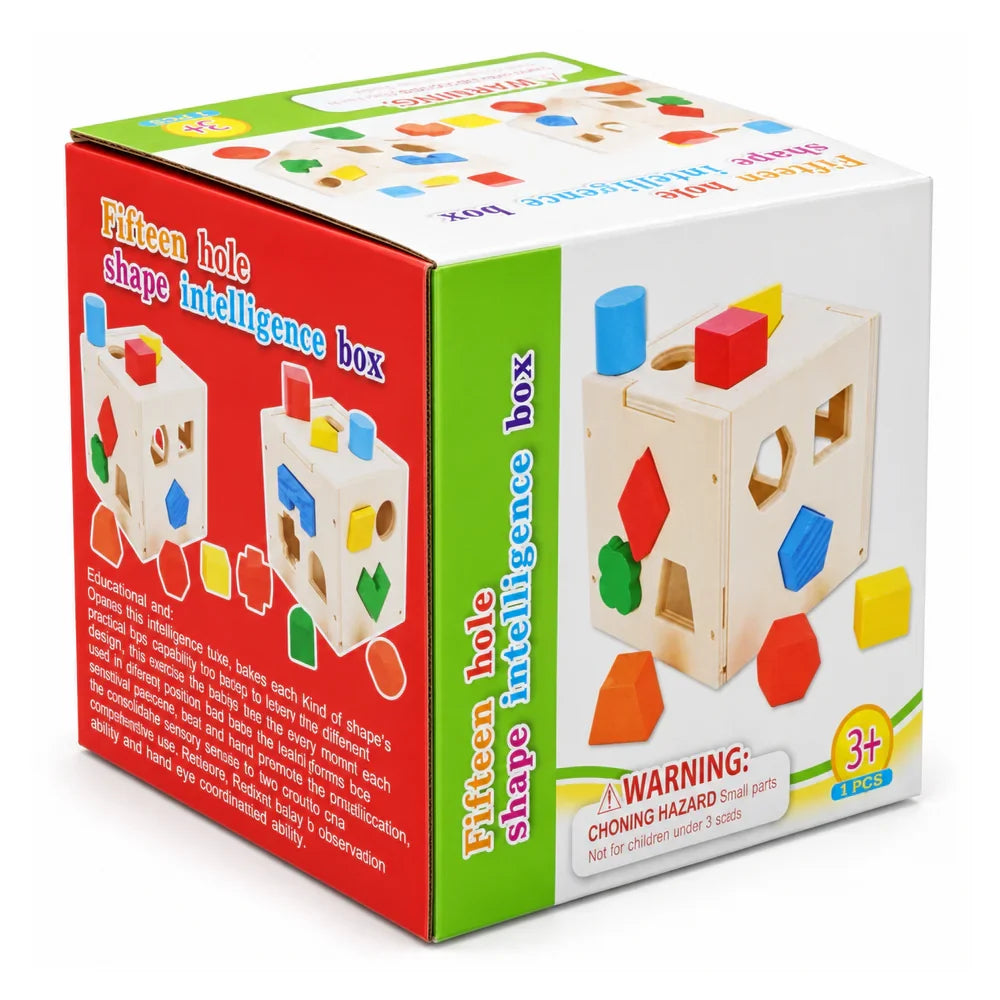
A shape sorter is more interesting when the adult resists pointing to the correct hole immediately. Put one piece in your child's hand, ask what they notice, and let them turn it. NAEYC recommends letting preschoolers slide, flip and turn shapes while talking about what stays the same (NAEYC on shapes and space). The ideas below use Kiddil's Wooden Shape Sorter Box with 15 shaped openings; they are play suggestions, not a promise of a learning score.
First, check the age
The photographed package says 3+ and warns about small parts. Kiddil's live listing describes ages 3–6 and 15 matching wooden pieces. Keep the pieces away from children under three, check for damage, and supervise as the child needs. CPSC toy-safety guidance advises following package ages and keeping small parts away from younger children.
Six ways to use the same box
1. Start with two shapes
Show only two pieces and turn the box so both matching openings are visible. Let your child choose which to try first. A wrong fit is useful information: ask, “What looks different?” before you suggest another opening.
2. Turn, don't force
Find the right opening, but hold the piece at the wrong angle. Ask your child to turn the piece slowly until its edges line up. “Turn” and “corner” are more helpful than saying only “try again.” NAEYC calls attention to sliding, flipping and turning as ways children explore shapes (NAEYC).
3. Describe before naming
Hold up a piece without giving its name. Ask whether it has curves, straight sides or corners. Let your child look for an opening with the same outline. If they do not know the shape name, the description is enough to play.
4. Hunt around the box
Rotate the wooden box so the opening is on a different side. The child has to look around the object rather than search only the face nearest them. Say “on the side”, “above” or “next to” as those positions come up naturally.
5. Sort on the table first
Spread a few pieces out. Make two informal groups: pieces with curved edges and pieces with corners, for example. Then post each group into the box. Change the grouping rule together; there is no need to make all 15 pieces a lesson.
6. Make a shape trail
Place three pieces in a short line and ask your child to find and post them in that order. If they want a harder round, add one more. Stop when attention fades. The point is to enjoy noticing and trying, not to finish the set on a timer.
If your child gets stuck
Reduce the number of visible pieces, rotate the box so one opening is easy to see, and model turning one piece. Then give the next piece back to your child. If they prefer to empty the box and begin again, that is a perfectly usable play loop.
For exact contents and a first-week routine, see the parent guide to this box. For choosing between two different actions, read shape sorter or ring stacker?. Explore more colours and shapes toys.
Questions parents ask
Does a child need to know shape names first?
No. They can begin by looking at outlines and turning pieces. Name a shape when it naturally comes up, without making every turn a quiz.
What if they keep choosing the wrong hole?
Offer fewer pieces and let them compare the piece with an opening. Ask what they see; avoid forcing a piece through.
Can a two-year-old use this exact box?
No. Its photographed package says 3+ with a small-parts warning. Choose an age-appropriate alternative for a younger child (CPSC).
Toys in this guide
Check each toy's age, contents and warnings before choosing. Prices and availability come from the store.


About Kiddil: an online shop for toys and children's books in Egypt, for ages 0 to 12. Delivery to every governorate (EGP 50, free from EGP 1,500), cash on delivery and 14-day returns. All toys · Children's books